There is a regulation that affects every restaurant in LA County, and most owners have never heard of it until they get cited.
It is called the 25% rule. And if your grease trap is over the limit when an inspector shows up unannounced, you are looking at fines that start at $500 and can climb to $5,000 or more per violation.
Here is exactly what the rule says, how inspectors enforce it, and what you need to do to stay on the right side of it.
What the 25% Rule Actually Means
The rule is straightforward in concept: the combined depth of floating grease and settled solids in your grease interceptor must not exceed 25% of the total liquid depth at any time.
Here is where most restaurant owners get confused. They think the 25% refers only to the layer of grease floating on top of the water. It does not. The measurement includes two layers:
Floating grease layer — the FOG that rises to the top of the interceptor
Settled solids — food particles and heavy waste that sink to the bottom
Both layers count toward the 25% threshold. An interceptor that looks fine on the surface can still fail inspection because of heavy solids accumulation on the bottom that you cannot see without measuring.
How the Measurement Works
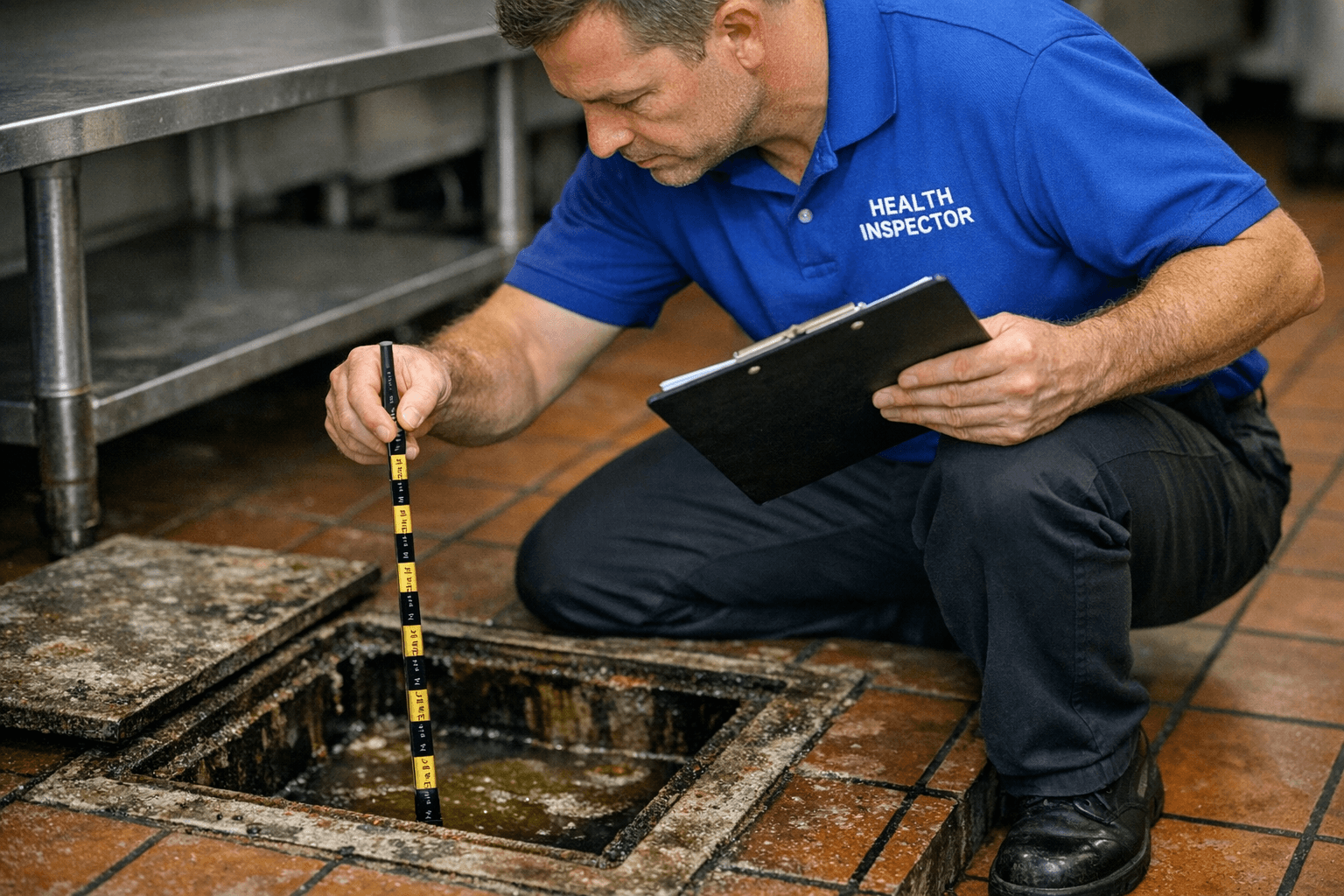
An inspector inserts a calibrated probe through the access opening and measures three values:
- Total liquid depth — from the bottom of the interceptor to the water surface
- Floating grease depth — the thickness of the grease layer on top
- Settled solids depth — the thickness of the solids layer on the bottom
The floating grease depth plus the settled solids depth is divided by the total liquid depth. If the result exceeds 0.25 (25%), you fail.
Example: Your interceptor has 40 inches of total liquid depth. The floating grease layer is 6 inches. The settled solids layer is 5 inches. Combined FOG and solids equals 11 inches. That is 27.5% of total liquid depth. You fail the inspection.
Who Enforces This
LA County's grease trap enforcement is split between several agencies, and which one inspects your restaurant depends on your exact location:
LA County Industrial Waste Division (LA County Public Works) — covers restaurants in unincorporated LA County
LASAN (LA Sanitation) — covers restaurants within the City of Los Angeles
LA County Sanitation Districts (LACSD) — covers specific sewer districts within the county
City-level wastewater departments — individual cities within LA County may have their own FOG programs with slightly different enforcement procedures
This jurisdictional overlap is one reason so many restaurant owners are confused about the rules. You need to know which authority has jurisdiction over your specific location.
Inspections Are Unannounced
FOG inspections in LA County are almost always unannounced. Inspectors do not call ahead. They do not schedule appointments. They show up during business hours, identify themselves, and ask to access your grease interceptor.
Inspections are triggered by:
- Routine scheduling — your restaurant comes up in the inspection rotation
- Complaint-based — a neighbor, employee, or anonymous caller reports a grease issue
- SSO event — a sanitary sewer overflow occurs near your property
- Follow-up — you received a previous violation and the inspector is checking correction
You have no way to predict when an inspection will happen. The only defense is being compliant at all times.
What Cleaning Frequency Keeps You Under 25%
The right cleaning schedule depends entirely on your cooking volume and menu. Here are general guidelines:
| Restaurant Type | Typical FOG Accumulation Rate | Recommended Cleaning |
|---|---|---|
| Coffee shop, bakery (no fryers) | Slow | Every 60 – 90 days |
| Sandwich shop, light grill | Moderate | Every 45 – 60 days |
| Sit-down restaurant with fryers | Moderate to heavy | Every 30 – 45 days |
| Fast food, fried chicken, fish fry | Heavy | Every 14 – 30 days |
| Asian cuisine with wok and deep fry | Heavy | Every 14 – 30 days |
| Buffet or large-volume kitchen | Very heavy | Every 7 – 14 days |
These are starting points. Your actual accumulation rate depends on your specific menu, daily covers, and kitchen practices. The best approach is to work with your cleaning provider to establish a data-driven schedule based on actual measurements during the first few service visits.
The Cost of Getting It Wrong
FOG violation penalties in LA County follow an escalation pattern:
First violation — Notice of Violation with a mandatory correction period (typically 30 days). Some jurisdictions issue warnings with no fine for the first offense.
Second violation — Administrative fine of $500 to $1,000 per incident. Mandatory increased cleaning frequency documented in writing.
Repeat violations — Fines escalate to $1,000 to $5,000 per incident. Required installation of monitoring equipment in some cases. Business license review.
SSO liability — If a grease-related sanitary sewer overflow is traced to your property, you face cost recovery charges for pipe cleaning and repair. These can run $5,000 to $25,000 or more depending on the severity of the blockage and any downstream property damage.
The 200-foot rule adds another layer of risk. Under current enforcement practices, any FOG-related blockage within 200 feet of your sewer lateral can trigger automatic liability unless you have documented manifests proving compliant maintenance.
How to Monitor Between Cleanings
You do not have to wait for an inspector to tell you whether your trap is over the threshold. Between professional cleanings, you or your staff can do basic monitoring:
Visual check (weekly): Open the access cover and look at the grease layer. If it appears thick or is approaching the outlet pipe baffle, schedule a cleaning sooner than planned.
Drain speed check (daily): If kitchen sinks or floor drains are draining slowly, FOG buildup in the interceptor may be restricting flow. This is an early warning sign.
Odor check (daily): A strong grease smell from the interceptor access area or from floor drains indicates heavy FOG accumulation.
Service provider monitoring: Some cleaning companies offer monitoring as part of their service agreement. They measure FOG levels at each visit and adjust your cleaning schedule based on actual data rather than a fixed calendar.
Best Management Practices That Slow FOG Buildup
Cleaning frequency is half the equation. The other half is reducing how much FOG enters your interceptor in the first place:
Scrape and dry-wipe dishes before washing. Most FOG enters the sewer system through dish washing. Pre-scraping food waste and wiping grease from pots and pans with paper towels before they go in the sink dramatically reduces FOG loading.
Never pour used cooking oil down any drain. This should be obvious, but it happens. Used fryer oil goes into your UCO collection container for pickup by a CDFA-licensed hauler. Every gallon poured down a drain accelerates interceptor filling and increases your cleaning costs.
Use drain screens on all kitchen sinks and floor drains. Screens catch food solids that would otherwise settle in your interceptor and contribute to the 25% measurement.
Train every kitchen employee. Your dishwasher, prep cooks, and line cooks all need to understand the basics. One untrained employee consistently pouring grease down the drain can double your FOG accumulation rate.
Documentation That Protects You
Every grease trap cleaning should generate documentation that you keep on file. Inspectors will ask for these records:
- Service date and time
- Volume of FOG removed (gallons)
- Condition assessment — was the interceptor approaching the 25% threshold?
- Service provider name and license information
- Manifest number
Keep a minimum of three years of service records. Store physical copies in a binder accessible to any manager on duty, and maintain digital backups. If an inspector visits and you cannot produce your records, you may receive a citation for inadequate documentation even if the interceptor itself is clean.
LA City vs. LA County: Key Differences
If your restaurant is in the City of Los Angeles (not unincorporated county), LASAN is your enforcement authority. The core 25% rule is the same, but there are procedural differences:
- LASAN may require a FOG Disposal Mitigation Plan for new food service establishments
- Inspection frequency may differ from county-level enforcement
- Reporting requirements for grease trap service providers may vary
- Fee structures for permits and inspections differ
If you are unsure whether your restaurant falls under city or county jurisdiction, call your local wastewater department or check your sewer bill for the issuing authority.
The Bottom Line
The 25% rule is not obscure. It is actively enforced, carries real fines, and applies to every restaurant in LA County. The good news is that compliance is straightforward: maintain a regular cleaning schedule based on your actual FOG accumulation, document every service visit, and train your staff on basic grease management practices.
The restaurants that get cited are almost always the ones that do not know the rule exists until an inspector is standing in their kitchen with a measuring probe. Now you know. The next step is making sure your cleaning schedule keeps you well below that 25% line.