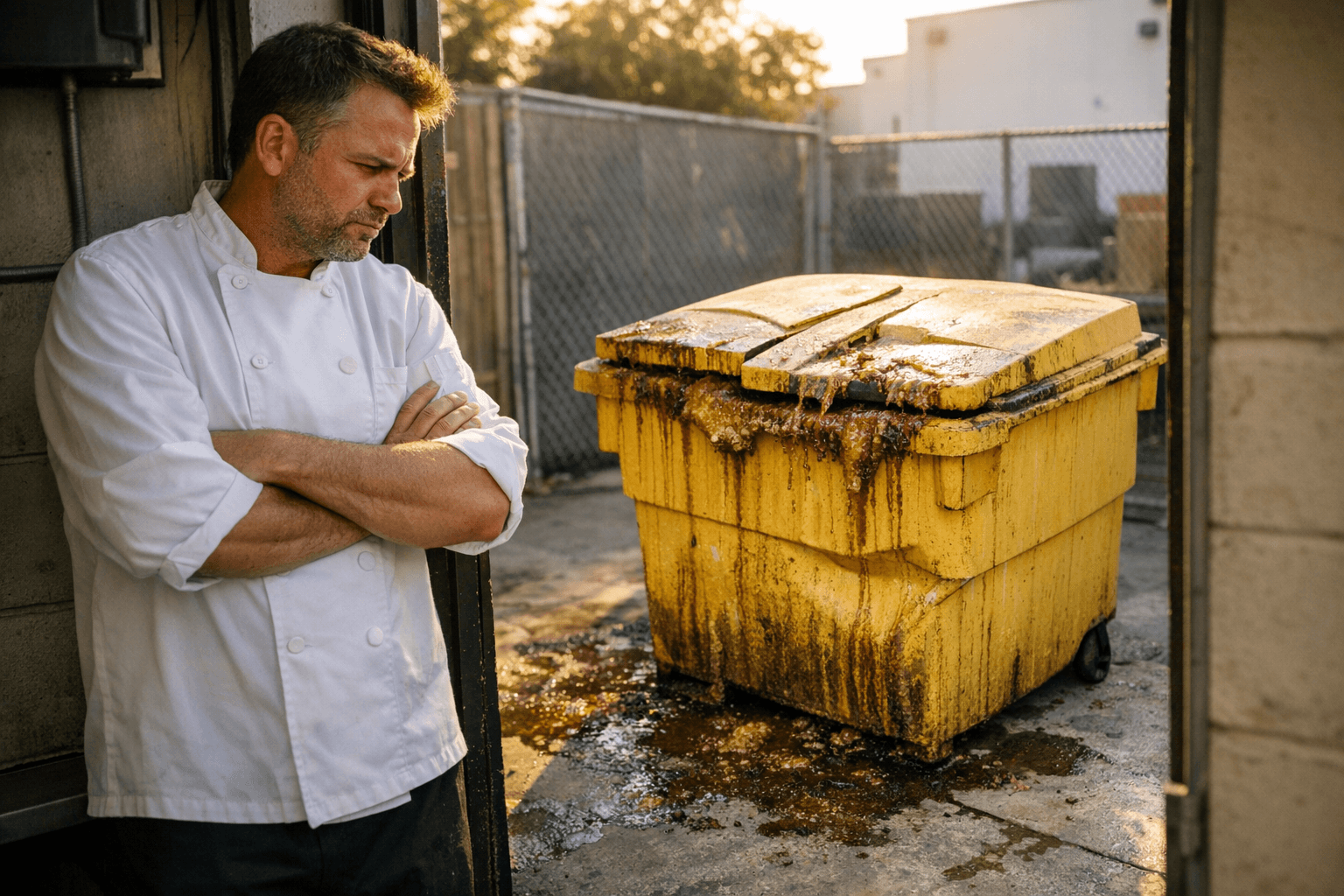
If you're new to operating a commercial kitchen in Southern California, or if you've been managing grease disposal on an ad hoc basis and want to get it organized, this guide is for you. Restaurant grease pickup is a regulated, recurring service that affects your health department compliance, your sewer system obligations, and in many cases your kitchen's profitability.
Here's everything you need to know — from the moment you contact a provider to what an ongoing service relationship looks like in practice.
What "Restaurant Grease" Actually Means
When people talk about restaurant grease pickup, they're typically referring to one or both of two things:
Used cooking oil (UCO): The oil that's been used in your fryers and is no longer suitable for cooking. This is pumped out of your fryers by kitchen staff, stored in designated sealed containers, and collected by a hauler on a scheduled basis. This oil has commodity value and is processed into biodiesel, renewable diesel, or animal feed products.
Grease trap waste: The accumulated sludge and liquid FOG (fats, oils, grease) that builds up inside your grease trap or grease interceptor — the device installed on your kitchen's drain system to prevent grease from entering the municipal sewer. Grease trap waste is a separate waste stream and must be hauled by a licensed pumping company.
Both types of grease are regulated. Both require licensed haulers. And both accumulate faster when your kitchen is busy. Most full-service restaurants need ongoing service for both.
The First Call: What Happens When You Contact a Provider
Getting set up with restaurant grease pickup service is simpler than most operators expect. Here's a typical onboarding sequence:
Step 1: Initial consultation. You provide basic details about your operation — number of fryers, estimated weekly oil volume, number of locations, access restrictions, and service area. This takes 5 to 10 minutes by phone or a quick online form submission.
Step 2: Site assessment. For larger accounts or multi-location restaurant groups, a provider representative may visit your location to assess container placement, access points, and any site-specific logistics. For standard single-location accounts, this step is often handled remotely based on the information you provide.
Step 3: Container delivery. Your provider delivers sealed collection containers — typically 35- to 55-gallon totes or barrels — and positions them at the agreed-upon outdoor storage location. Kitchen Oil Recycling's free used cooking oil pickup service includes container supply at no charge for qualifying accounts.
Step 4: Training your staff. Best practice is to walk your kitchen staff through the transfer process: how to drain the fryer safely, how to use the transfer pump or hose if provided, how to seal the container after each use, and what to do if the container approaches capacity before the next scheduled pickup.
Step 5: First pickup and ongoing service. Your first scheduled pickup happens on the agreed date. The driver arrives, drains or swaps the collection container, leaves a service ticket documenting the pickup, and departs. Ongoing service follows the same routine.
Container Requirements and Placement
One of the most common compliance gaps for Southern California restaurants is improper used oil storage. Health departments and environmental inspectors look at container condition, placement, and labeling.
Container specs that matter:
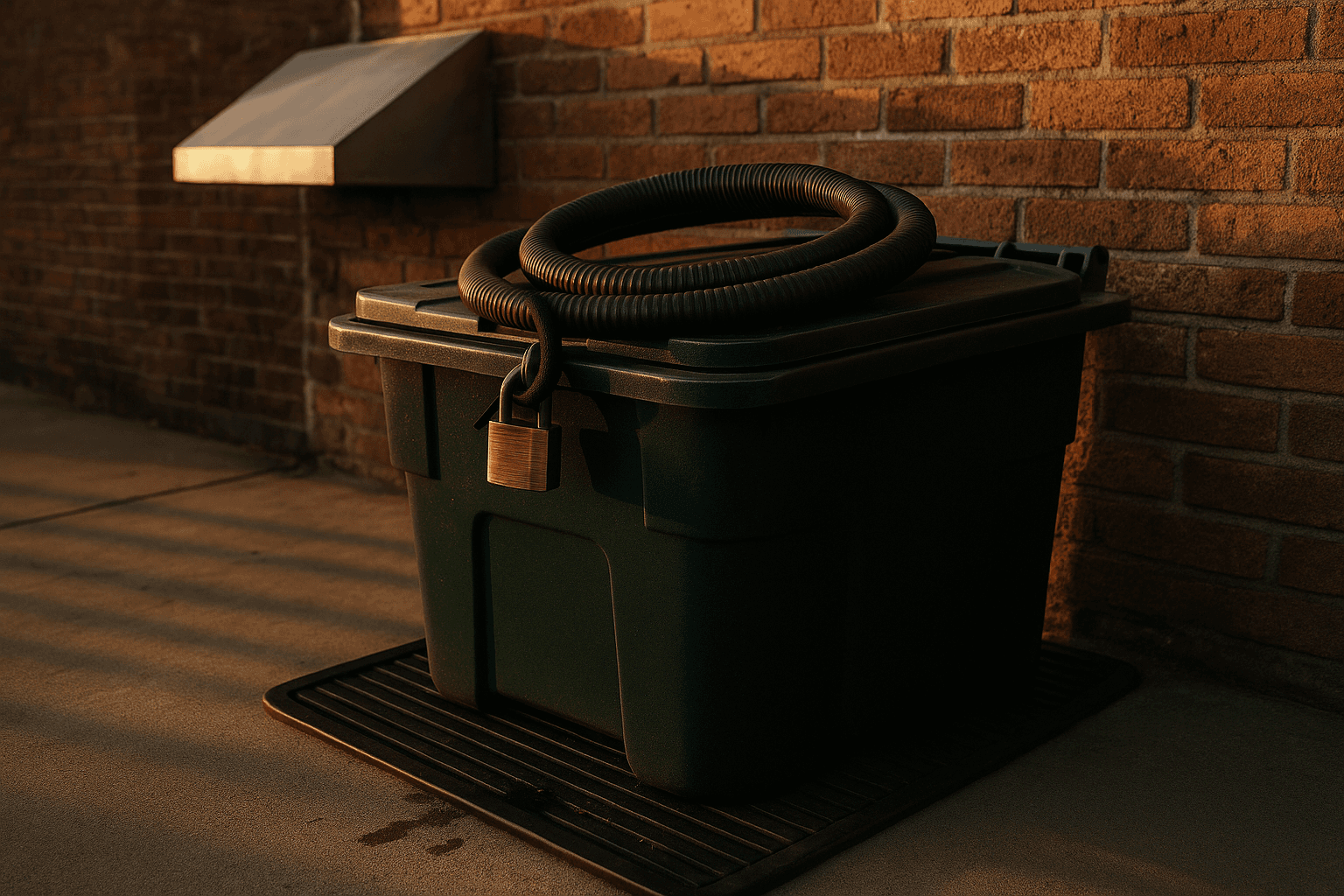
- Sealed, leak-proof construction. Lids must close fully and stay closed. Open-top containers, buckets with ill-fitting lids, or damaged barrels that show staining or seepage are non-compliant.
- Food-grade or industrial-grade material. Standard options are high-density polyethylene (HDPE) totes or galvanized steel barrels. Cardboard, thin plastic, or improvised containers are not acceptable.
- Clear labeling. Containers should be labeled with "USED COOKING OIL" or "UCO" to prevent misuse and to clearly identify the waste stream for inspectors.
Placement requirements:
- On a hard, impermeable surface — poured concrete or compacted asphalt. Not gravel, soil, or wood pallets placed on soil.
- Away from storm drains and catch basins. If a container were to leak, the spill should not be able to reach a storm drain without being intercepted. Many municipalities in LA County, Orange County, and San Diego County have specific setback requirements.
- Accessible to your service vehicle. Your provider's truck needs to be able to reach the container without significant obstacles. Locked gates are fine — just ensure your provider has a key or combination code.
- Away from public areas. Containers should not be visible from dining areas or customer entrances. Rear or side of building placement is standard.
How the Pickup Process Works in Practice
On pickup day, the typical service visit looks like this:
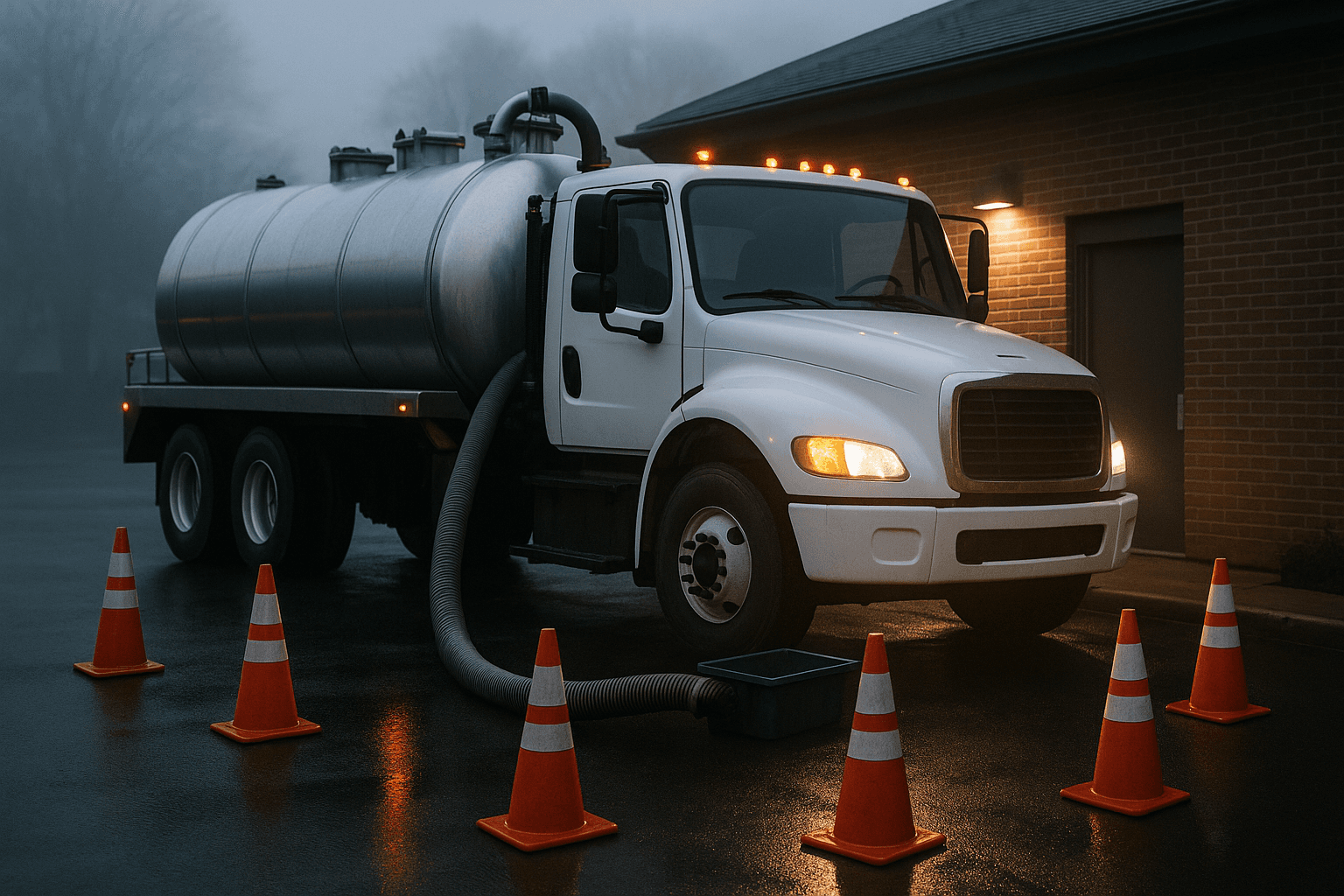
- The driver arrives at your location during the agreed service window (most commonly early morning, before kitchen activity ramps up)
- The driver inspects the container for damage or spills
- Oil is pumped from your collection container into the service vehicle's tank, or the entire container is swapped for a clean empty unit
- The driver documents the volume collected and leaves a service ticket at your location
- The used oil is transported to a licensed processing or rendering facility
The entire process for a standard single-container account takes 10 to 20 minutes. For accounts with multiple containers or combined grease trap service, the visit may run longer.
Your service ticket is important — keep it. These records demonstrate compliance in the event of an environmental inspection or health department audit. Kitchen Oil Recycling provides digital service documentation for all pickups, which makes record-keeping easier for multi-location operations.
Compliance Requirements in Southern California
Southern California's regulatory environment for restaurant grease is more structured than many operators realize. Here's what matters:
CDFA licensing. Any company collecting used cooking oil in California must hold a valid California Department of Food and Agriculture (CDFA) rendering license or waste hauler registration. Before signing up with any provider, ask for their CDFA license number and verify it at the CDFA website.
Manifest documentation. California requires that used cooking oil shipments be accompanied by documentation linking the generator (your restaurant) to the licensed hauler and the receiving facility. Your service ticket or manifest fulfills this role.
Municipal FOG programs. Most cities in Los Angeles County, Orange County, and San Diego County participate in regional FOG (fats, oils, and grease) control programs that set standards for restaurant grease management. These programs typically require restaurants to maintain grease traps in good working order, dispose of used cooking oil through licensed haulers, and keep service records on file.
Grease trap cleaning compliance. If your restaurant has a grease interceptor, it must be cleaned on a schedule set by your local sanitation authority — typically every 60 to 90 days for active kitchens, though this varies. Kitchen Oil Recycling's grease trap cleaning service covers both interior and exterior interceptor units throughout Southern California. Combining grease trap service with used oil pickup under one provider simplifies scheduling and ensures your documentation is consolidated.
What to Expect in an Ongoing Service Relationship
A good restaurant grease pickup provider is more than a hauler — they're a compliance partner. Here's what ongoing service should look like:
- Consistent scheduling — pickups happen when promised, not when it's convenient for the hauler
- Proactive communication — you're notified of schedule changes with enough lead time to manage your storage
- Volume-based adjustments — your frequency is reviewed periodically and adjusted if your kitchen's output changes
- Documentation — service tickets or digital records provided for every pickup without you having to request them
- Responsive service — when you have an overflow situation or urgent need, you can reach someone and get a driver dispatched
If your current provider isn't delivering on these basics, that's worth addressing — either by having a direct conversation about expectations or by exploring alternatives. Kitchen Oil Recycling services the full Southern California region including Orange County, Los Angeles, and San Diego, with routes designed to accommodate same-week or next-day schedule changes.
Bulk Oil Disposal for High-Volume Operations
High-volume operations — large restaurant groups, institutional cafeterias, hotel kitchens, food manufacturers — often generate used cooking oil in quantities that go well beyond standard tote service. For these accounts, bulk disposal solutions make more operational sense.
Kitchen Oil Recycling's bulk cooking oil disposal and recycling service handles large-volume accounts with tanker pickups, dedicated account management, and volume-based pricing structures. If you're managing a central kitchen, a hotel food and beverage operation, or a multi-unit restaurant group generating hundreds of gallons per week, bulk service is worth exploring.
Getting Started
If you've been managing restaurant grease pickup on an informal basis — or not managing it at all — getting onto a proper, compliant service program is straightforward. The setup process takes one conversation and a few days for container delivery and scheduling.
Contact Kitchen Oil Recycling to discuss your operation's needs. We cover all of Orange County, the Greater Los Angeles area, and San Diego County with licensed, documented, no-hassle service. For most qualifying kitchens, used cooking oil pickup is completely free.